
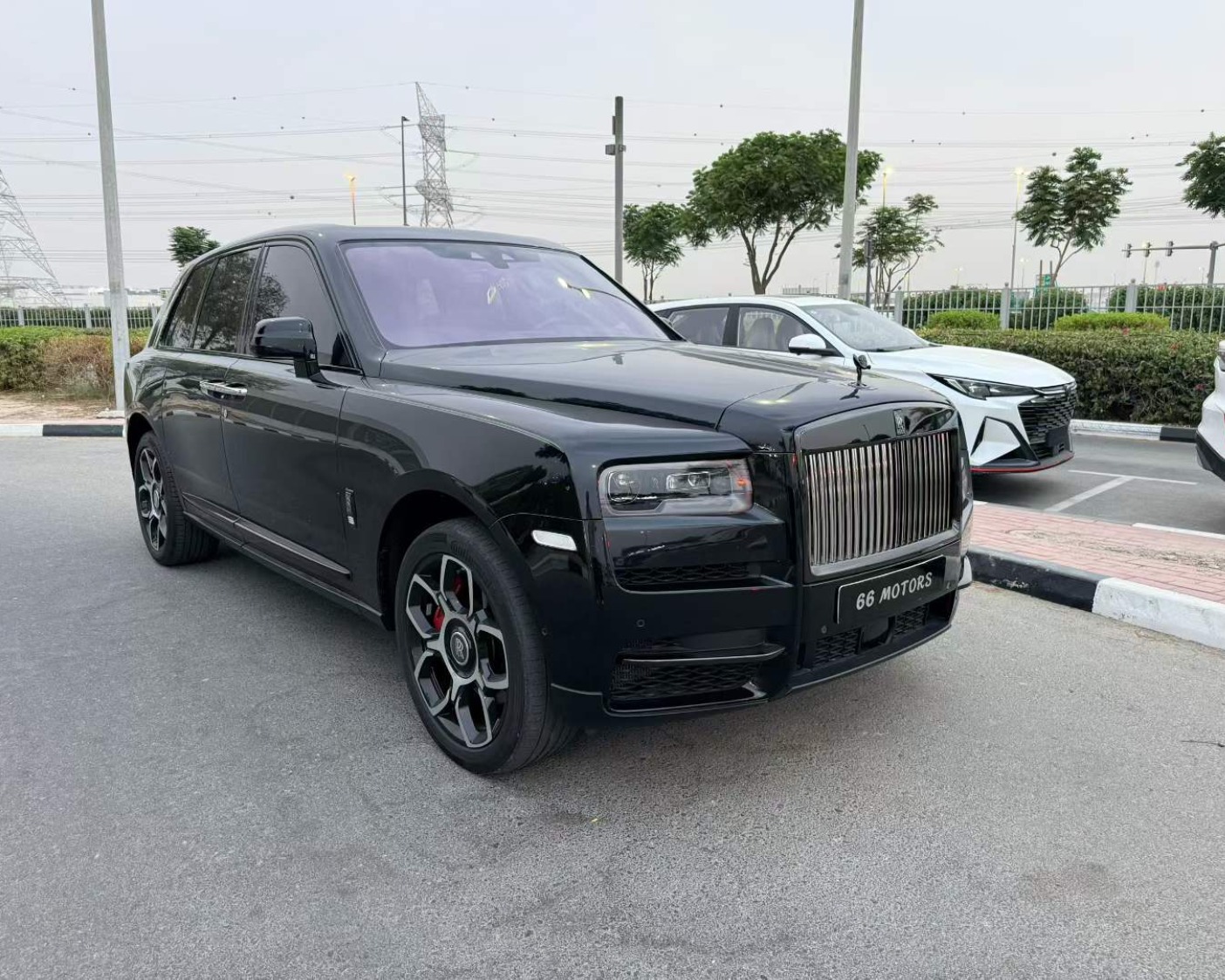
 Exterior · 1 / 9
Key Vehicle Info
Description
We are offering this 2023 Rolls-Royce Cullinan Black Badge with GCC regional specification, a recorded 20,000 km, and an asking price of AED 1,299,900. The exterior appears black and the cabin appears green and black, a bold combination that suits the more assertive character associated with the Black Badge name. The vehicle is in Dubai, and we welcome a serious buyer who wants to inspect it carefully rather than rely on a model badge or a first impression. Nothing in this description replaces an independent examination: equipment, operation, documents, history, condition, and transaction terms should all be established on the actual vehicle before purchase.
The Cullinan is Rolls-Royce’s interpretation of an ultra-luxury SUV, so its appeal is broader than simple transport. Buyers commonly approach the model for its commanding format, refined atmosphere, passenger focus, and distinctive public presence. Black Badge generally expresses the darker and more dynamic side of the model family, but the exact content of any individual car depends on its specification. I therefore present the verified year, identity, regional specification, mileage, price, and observed colors directly, while inviting you to verify every feature that matters to you during a viewing.
If a 2023 Black Badge, GCC identity, 20,000 km, black exterior appearance, green-and-black cabin appearance, and AED 1,299,900 asking price fit your search, contact us to arrange a measured viewing in Dubai. Bring your priorities, allow time for a proper inspection, and judge this Cullinan on evidence as well as emotion.
1. Character, suitability and the reason to view
- This Cullinan makes sense for a buyer who deliberately wants the scale and occasion of an ultra-luxury SUV. Before visiting, think through where the car will be driven, who will use its passenger space, how often it will enter tight parking areas, and whether its visual presence suits your everyday life. That short exercise separates genuine fit from admiration at a distance. At the appointment, compare your expectations with the seating position, outward view, access, cabin ambience, and the effort required for ordinary maneuvers.
- The Black Badge identity is an important part of this listing because it usually attracts buyers seeking a more assertive interpretation of Rolls-Royce luxury. Treat that identity as a starting point, not permission to assume a catalogue of equipment. Examine the actual finishes, controls, displays, personalization details, and driving responses that are present. If a particular option influences your willingness to buy, ask us to demonstrate it, record it in the written agreement, and have its correct operation checked before funds change hands.
- The apparent black exterior gives the vehicle a formal, strong profile, while the apparent green-and-black cabin offers a less conventional contrast. Colors can look different under showroom lamps, shade, midday sun, cameras, and screen settings, so inspect both finishes in natural light. Consider whether the combination remains appealing beyond the initial impact and whether it works with your preferred cleaning routine.
- A recorded 20,000 km on a 2023 vehicle can help frame the conversation, yet odometer distance cannot describe how those kilometres were accumulated or how the car was treated between journeys. Use the figure to structure questions about dates, service events, tires, consumables, and periods of storage. Then compare the dashboard reading with documents and diagnostic information available to your inspector. Consistency across independent evidence matters more than a low number considered alone, particularly when the purchase sits in this price category.
- The asking price is AED 1,299,900. Decide on a complete acquisition ceiling before discussing a transaction, including inspection, insurance, registration, transfer, immediate maintenance, protection work, and a prudent reserve. This prevents a desirable specification from pushing the rest of the ownership plan out of view. We welcome informed questions and a serious inspection; the strongest enquiry is one that understands both the appeal of the car and the responsibility attached to maintaining a complex ultra-luxury vehicle.
2. Preparing a productive Dubai viewing
- Arrange the visit when there is enough daylight to examine reflections, panel alignment, glass, wheels, cabin materials, and color consistency. Allow more time than you would for an ordinary walk-around, because a premium vehicle contains many surfaces and functions that deserve individual attention. If the car has just been cleaned, look past the presentation and focus on what the finish reveals from several angles. Bring a light, a phone for notes, and a written list of the items that would materially affect your decision.
- Ask for this sequence: document review, exterior inspection, cabin assessment, function checks, professional examination, and then a road test if arrangements permit. Moving in that order reduces the chance that excitement from the drive distracts from identity or condition questions. It also lets your specialist follow observations made during the static review. Avoid turning the appointment into a race; uncertainty that could be resolved in ten extra minutes may otherwise become an expensive question after ownership begins.
- If practical, observe startup before the vehicle has been brought fully to operating temperature. Watch the instrument display, listen without conversation, notice how the idle settles, and give the climate system time to respond. This is not a claim that any issue exists; it is simply a more informative way to see one phase of operation. A warmed and staged vehicle can still be inspected properly, but note the starting condition so your specialist understands which behaviours were and were not available for observation.
- Bring every person whose comfort or approval genuinely matters, especially if the Cullinan will regularly carry family, clients, or a driver. Let passengers enter and exit, adjust their seating environment, assess sightlines, and consider the luggage they commonly take. If child seats, mobility needs, tall occupants, or ceremonial use are part of the plan, reproduce those requirements rather than guessing from dimensions. A prestigious cabin must also solve the buyer’s practical brief; personal testing is the quickest way to reveal mismatches.
- Plan a lawful route that includes parking-speed movement, turns, braking, a stretch of urban driving, and a smoother higher-speed section where conditions allow. The objective is not aggressive performance testing. It is to understand visibility, size, pedal calibration, steering response, ride behaviour, cabin noise, and your confidence in real traffic. Agree on the route and insurance arrangements beforehand. If a full drive cannot be offered at the first meeting, decide what access you need before advancing to a binding commitment.
3. Identity, GCC specification and transaction documents
- Begin the documentary review by matching the vehicle’s chassis identity to the registration record and every paper that will support the sale and transfer. Characters should agree exactly, with no reliance on a handwritten shorthand or a photograph that hides part of the identifier. Ask your inspector to locate the relevant physical identifiers and look for ordinary consistency around them. Identity verification protects both parties and should be completed before any substantial payment, regardless of how convincing the rest of the presentation may be.
- Confirm that the 2023 model year, Rolls-Royce Cullinan designation, Black Badge identity, and GCC regional specification align between the car, registration information, and supporting records. GCC specification is a meaningful verified listing point, but it does not by itself enumerate every fitted option or prove a condition standard. Where configuration matters, use vehicle-specific data and physical inspection. A clear written description of the exact car being purchased is more useful at handover than assumptions borrowed from another Cullinan, another market, or a generic brochure.
- Review the current ownership and registration position, then establish what the responsible UAE authority requires for inspection, transfer, plates, insurance, and any finance clearance that applies to the transaction. Requirements and fees can change, so confirm them through the relevant authority or licensed provider at the time of purchase. Agree who will arrange each step, when payment becomes final, and what happens if a mandatory transfer condition is not met. A transparent sequence keeps administrative uncertainty from becoming commercial pressure.
- Read service invoices, inspection sheets, campaign entries, approvals, and dated correspondence as one timeline rather than a pile of isolated documents. Look for agreement among dates, mileage entries, vehicle identifiers, workshop names, described work, and recommendations. A stamp without supporting detail answers less than an itemised record; an unexplained gap is a question, not automatic proof of neglect. Give any unclear entry to a qualified specialist who can distinguish routine wording from information that changes the technical assessment or the immediate maintenance budget.
- Put all commercial terms into the final agreement: AED 1,299,900 asking price or the ultimately agreed price, exact vehicle identity, recorded handover mileage, included keys and items, payment route, transfer responsibilities, timing, and the condition in which the vehicle will be handed over. Verbal expectations about accessories, repairs, detailing, or later assistance are difficult to evaluate after completion. If a point affects value, write it clearly. Never send money to an unverified account or sign an incomplete document merely to hold your place.
4. Exterior finish, body details and underside
- Study the apparent black paint in even daylight from low, straight, and oblique angles. Dark finishes can make dust and fine marks visible, while strong reflections may also hide changes in texture. Compare gloss, orange peel, hue, and reflection across adjacent panels without assuming that a difference proves previous work. Inspect edges and openings as well as broad surfaces. If anything looks inconsistent, a competent paint-depth and body assessment can explain far more than speculation during a walk-around.
- Check panel gaps, fasteners, seals, lamps, glass markings, trim alignment, door operation, and the areas around hinges and latches. The purpose is to build a coherent picture of assembly and use, not to declare history from one screw or gap. Photograph noteworthy findings and ask the independent inspector to determine whether they are cosmetic, adjustment-related, repair-related, or entirely normal. On a vehicle at this value, ambiguity should be investigated patiently because small presentation details and structural questions belong in very different decision categories.
- Move beyond eye level. Examine lower bumper zones, sill areas, wheel arches, the front edge, roof surfaces, luggage opening, and parking-contact points where ordinary use may leave different evidence. A safe lift inspection can reveal covers, mounts, leaks, impact marks, corrosion, or repairs that cannot be assessed from the floor. Do not crawl beneath an unsupported vehicle. Request photographs in the inspection report so that any recommendation can be discussed with the car in front of you and revisited after the appointment.
- Inspect each wheel for finish damage, deformation, prior repair indications, missing hardware, and consistency with the car’s specification. Read every tire’s brand, model, size, load and speed markings, production date, tread depth, sidewall condition, and wear pattern. Matching appearance does not guarantee matching age or construction. Uneven wear may have several causes, so let a technician relate it to pressure, alignment, suspension, or use. Obtain replacement pricing before purchase if age or condition places tires near your chosen renewal threshold.
- Assess glass and exterior lighting in daylight and again with the systems switched on. Look for chips, cracks, internal moisture, damaged lenses, poor sealing, and inconsistent output, while remembering that exact lamp functions depend on the fitted configuration. Confirm washers, wipers, door handles, openings, and closure assistance only where present. Cosmetic perfection must never be inferred from a polished black surface; equally, a minor mark should not be inflated into a structural conclusion without professional evidence and a proportionate repair estimate.
5. Green-and-black cabin, comfort and practical use
- View the apparent green-and-black interior under natural light before deciding how you feel about its tone and contrast. Walk through the cabin slowly, checking seats, piping, panels, door cards, carpets, headlining, luggage surfaces, and the transitions between materials. Different components age and clean differently, so compare areas exposed to hands, clothing, sunlight, and cargo. Ask a material-care specialist before attempting treatment on an unfamiliar finish; an unsuitable chemical can create a more expensive problem than the mark it was meant to remove.
- Sit in every position relevant to your intended use and take time to establish a comfortable posture. Check headroom, legroom, entry movement, outward visibility, reach to controls, and the ease with which passengers can communicate. If a chauffeur will drive, evaluate the rear experience and the driver’s working position together rather than as separate worlds. If you will drive yourself, make sure the commanding format feels manageable in Dubai traffic and parking, not merely impressive while stationary.
- Operate the functions that matter to you one by one. Observe response speed, travel, sound, display messages, illumination, and whether a control behaves consistently over repeated use. Do not infer equipment from the Black Badge name, the model family, or another advertisement; specification varies. Create a personal must-have list before arrival, then have every listed item demonstrated on this car. A feature should influence price only after its presence and basic operation are established, with deeper electronic assessment left to the specialist.
- Give the climate system enough time to work from different seating positions in Dubai conditions. Check airflow changes, temperature response, fan operation, vent adjustment, unusual odours, and any warning shown during the test. Cabin cooling depends on ambient heat, how long the vehicle has been standing, door openings, settings, and mechanical health, so record the circumstances instead of making a snap judgment. If performance is important to your routine, ask the inspection centre for measured diagnosis rather than accepting a vague impression.
- Recreate ordinary use with the luggage, devices, garments, or accessibility needs that matter to you. Check loading height, opening space, storage for small items, door clearance in a realistic bay, and the protection required for delicate cabin surfaces. Pair your phone only with permission, remove personal data afterward, and test charging or connectivity solely where fitted. Luxury becomes useful when the cabin supports repeated habits without anxiety; this practical rehearsal tells you more than a long feature list disconnected from your life.
6. Controls, diagnostics and electrical assessment
- Before startup, note which warning indicators illuminate as part of the normal check and whether they clear in the expected sequence. Photograph any persistent message for the inspector rather than dismissing it or diagnosing it yourself. Cycle through available vehicle information screens and compare the recorded 20,000 km with the documentary timeline. Unexplained alerts deserve written investigation before purchase.
- Use a diagnostic scan performed with suitable equipment and interpreted by someone familiar with the marque. Ask for current, stored, pending, and recently cleared faults where the tooling permits, plus system readiness and relevant measured data. A code is not automatically proof that a component has failed, and no-code results cannot certify the whole vehicle. The value lies in combining scan information with symptoms, service records, physical checks, and a road test, then receiving prioritized findings in language you can use for budgeting.
- Test switches, displays, cameras, sensors, lighting, locks, windows, mirrors, seat movements, and other fitted functions systematically without rushing across the cabin. Record intermittent behaviour, lag, unusual noises, partial movement, or functions that require repeated commands. Some systems operate only under specific safety conditions, so consult correct instructions before labelling them faulty. Where an item is central to your purchase, request a second demonstration and make its status explicit in the transaction rather than relying on memory after the viewing.
- Ask the specialist to evaluate battery condition, charging behaviour, visible connections, and evidence of low-voltage events in context. Dubai heat and storage patterns can influence batteries, but age or a past warning alone does not reveal the complete cause. Establish whether the car has been maintained with appropriate support during inactivity and whether any replacement or registration procedure is relevant to the fitted system. A stable electrical baseline matters because low voltage can produce multiple messages that obscure rather than identify the underlying issue.
- Check that all available keys are recognized and that their buttons and access functions operate as intended. Clarify how many keys and remotes form part of the sale, then list them in the agreement. Replacement and programming can involve time, security controls, and material cost, so this small inventory deserves attention before handover. Treat entertainment accounts, navigation destinations, paired devices, access profiles, and stored addresses as private data; both parties should remove personal information and reset only through an appropriate, understood procedure.
7. Mechanical inspection and fluid evidence
- Commission an independent pre-purchase inspection by a workshop with appropriate experience of complex Rolls-Royce vehicles. The report should identify the car, date, mileage, scope, limitations, observations, measurements, diagnostic results, and recommended priorities. A general visual check may be useful but should not be represented as a specialist mechanical conclusion. Ask the inspector to separate safety-critical work, current faults, routine maintenance, cosmetic matters, and monitor-only observations, because those categories affect timing and negotiation in very different ways.
- Observe the ground under the vehicle and inspect accessible areas for fresh fluid traces, dried residue, damaged covers, or unusual smells. Fluid presence must be identified correctly; condensation water, protective products, and leaks are not interchangeable findings. Let the workshop inspect levels and condition using the correct procedures, since opening hot or pressurized systems is unsafe and some measurements require particular temperatures or electronic routines. Written identification of source and urgency is more valuable than a casual assurance that a trace is normal.
- Have braking components assessed for remaining material, disc condition, warning status, hydraulic evidence, and behaviour during a safe drive. Pedal feel, stopping smoothness, noise, vibration, and directional stability all contribute information, yet road impressions alone cannot measure concealed wear. Ask for figures where measurement is possible and price any approaching work using parts and labour suitable for this vehicle. A heavy, powerful luxury SUV deserves a braking budget based on evidence rather than ordinary-car assumptions or cosmetic inspection through the wheel.
- Request evaluation of steering, suspension, mounts, joints, bushes, dampers, wheel bearings, and ride-height behaviour applicable to the actual configuration. During low-speed turns and varied surfaces, listen for repeatable noises and notice pulling, vibration, delayed settling, or inconsistent stance without trying to name the cause. The model is generally valued for refinement, making a careful baseline especially relevant, but no reputation guarantees this car’s condition. Let the technician connect road symptoms to lift inspection and diagnostic data before suggesting parts.
- Examine cooling-related evidence with UAE use in mind: visible hoses and connections, fluid condition where safely accessible, fan operation, temperature behaviour, warning history, and signs of previous intervention. Heat places importance on a healthy system, although one stable gauge reading during a short drive is not a guarantee. Ask what further testing is justified by the initial findings and whether any time-based work is approaching. The goal is not to invent risk; it is to price known maintenance and reduce uncertainty before committing.
8. Road-test observations and driving fit
- Start with low-speed manoeuvres in a safe open area. Learn the steering weight, turning space, brake take-up, throttle response, visibility over the body, and assistance views that are actually fitted. Notice whether the Cullinan’s dimensions feel intuitive after several attempts or continue to demand more concentration than your routine allows. This is personal suitability, not a contest of skill. A buyer who regularly uses tight hotel entrances, basement ramps, or compact home parking should test those demands conceptually before being carried away by an effortless straight road.
- Listen at idle, gentle acceleration, steady speed, lift-off, braking, and full steering movement where safe. Separate a sound that occurs once from one that can be reproduced under the same conditions, then give the specialist a precise description of speed, temperature, direction, and control input. Avoid diagnosing through vocabulary such as “normal luxury-car noise.” A repeatable observation is useful even when the cause is unknown; it gives the workshop a path to investigate without turning a buyer’s impression into an unsupported claim.
- Assess ride behaviour over surfaces that represent your normal travel while respecting the vehicle, passengers, and local law. Observe how the body settles after undulations, how impacts are communicated, whether the steering remains calm, and whether any vibration changes with road speed or engine demand. Tire pressures, tire construction, alignment, load, and surface quality can all affect sensation. Note the conditions so that a technician can interpret the result instead of treating every movement as a defect or every smooth stretch as proof of perfection.
- Check straight-line tracking and braking on a suitable, safe road with the driver ready to correct for traffic, wind, camber, and surface changes. Any pull or vibration should be repeated cautiously before it is recorded, since road shape can mislead. If a pattern remains, stop trying to diagnose it during the drive and refer it for alignment, tire, brake, or suspension assessment. A composed test should leave both parties with useful facts, not expose the car or other road users to unnecessary risk.
- After the drive, keep the vehicle running briefly where permitted and look again for messages, smells, fan activity, fluid evidence, or a change in idle. Then switch off and restart only if the agreed inspection calls for it. Write your observations before conversation reshapes your memory. Finally, ask yourself whether the driving position, response, refinement, and sheer size suit the journeys you actually make. Model prestige can open the door, but comfort with the car in motion should determine whether the relationship is sustainable.
9. Service history, maintenance timing and specialist support
- Organize every available maintenance record by date and mileage, then compare the sequence with the manufacturer schedule applicable to the vehicle’s age, use, and regional context. Look beyond headline services to itemised fluids, filters, inspections, consumables, software work, campaigns, and recommendations. The purpose is not to reward a thick folder automatically; it is to understand what was done, by whom, at what mileage, and what remained advisory. Ask for clarification when a description is too broad to support a confident conclusion.
- Calendar time matters alongside the recorded 20,000 km. Fluids, rubber, tires, batteries, filters, and inspection routines can be influenced by age, heat, use patterns, and storage even when annual distance is modest. Ask a marque-competent workshop which tasks are due now, which are approaching, and which depend on inspection rather than a simple interval. This turns “low mileage” from a sales phrase into a practical maintenance plan and prevents the first ownership year from being budgeted solely around distance-driven work.
- Verify significant specialist work where possible by matching invoice identifiers, dates, mileage, part descriptions, and contactable workshop details. Do not publish or circulate private information unnecessarily, but obtain enough evidence to establish that relevant records belong to this chassis. If previous recommendations were deferred, ask whether they were later completed elsewhere or still require attention. A missing follow-up can represent anything from duplicate advice to a real outstanding need; only supporting evidence and present inspection can place it correctly.
- Identify suitable support before purchase, not after the first warning. Compare authorised and reputable independent options for diagnostic capability, technical experience, parts access, booking time, transport arrangements, and written estimates. The cheapest hourly figure may not produce the lowest final cost if diagnosis is uncertain or work must be repeated. Conversely, a famous name does not remove the need for clear scope and documented results. Choose providers according to the job and keep communication precise enough that approvals cannot be misunderstood.
- Ask the inspector for a twelve-month outlook divided into immediate, near-term, routine, optional, and contingency items. Add realistic parts, labour, tax, transport, and downtime assumptions rather than one optimistic total. This forecast is not a promise that every item will arise; it is a planning tool that makes the AED 1,299,900 purchase easier to compare with alternatives. If a large recommendation appears, seek an evidence-based second opinion before rejecting the vehicle or approving expensive work.
10. UAE climate, parking and everyday ownership
- The verified GCC specification is relevant for a Dubai buyer, but continue to judge the exact vehicle rather than treating the regional label as a universal condition certificate. Confirm configuration through its own data, inspect cooling and climate performance, and ask how maintenance has addressed local use. GCC identity and good upkeep answer different questions. Keeping them separate helps you value a genuine regional specification without overlooking tires, batteries, seals, fluids, or other components affected by time and environment.
- Dubai heat makes shaded or covered parking, effective cabin cooling, sensible battery care, and regular tire checks important planning topics. Strong sun can affect exterior presentation and cabin materials, while long stationary periods create different needs from frequent use. Discuss protection methods with specialists familiar with the actual surfaces; avoid assuming every coating or cleaner is appropriate. A consistent care routine, gentle cleaning, and prompt attention to new symptoms are more useful than occasional dramatic treatment without an understood maintenance baseline.
- Dust and sand reward careful washing practices. Loose contamination should be removed with methods that limit rubbing, and towels or tools used on lower dirty areas should not be carried across delicate paint or cabin materials. Ask a professional detailer to assess the apparent black finish before paint correction, polishing, film, or coating work, because each intervention changes the surface in a different way. Preserve originality where appropriate and keep invoices for any protection service so future care follows compatible products and procedures.
- Measure your parking reality. Consider bay width, ramp angle, height clearance, turning room, door opening space, security, charging access for personal devices, and the possibility of heat exposure during long stays. Practice alignment using only the assistance equipment present on the car and maintain physical observation around people and low obstacles. If home or workplace access is marginal, solve it before purchase. Daily anxiety around one gate or basement corner can outweigh the pleasure delivered on open roads.
- Plan UAE administration as part of ownership: insurance suited to the driver and intended use, registration renewals, inspections where applicable, tolls, parking accounts, fines management, and procedures for travel between emirates or beyond the country. Obtain current terms directly from authorities and licensed providers because eligibility, documents, prices, and coverage can change. Keep digital and paper copies organized securely. A smooth administrative routine protects the time value of a car chosen partly for convenience and occasion.
11. Insurance, finance and total cost planning
- Request insurance indications before making a binding commitment, using the exact vehicle identity, value, driver profile, intended use, parking situation, repair preferences, and any cross-border needs. Compare exclusions, excess, agency or workshop provisions, valuation method, geographical limits, roadside support, and claim procedures instead of focusing only on premium. Approval and terms belong to the insurer. A quotation that does not reflect the actual driver or vehicle may be a poor basis for planning even if its headline cost looks attractive.
- If finance is relevant, treat the simple examples below only as arithmetic divisions of the asking price: approximately AED 36,108 over 36 months or AED 21,665 over 60 months before any down payment, profit or interest, fees, insurance, or lender conditions. They are not offers and do not predict approval or an actual instalment. Obtain a written quotation showing total payable, rate basis, deposit, charges, early-settlement rules, and required security, then compare that full cost with a cash purchase and your liquidity priorities.
- Build a first-year ownership sheet with separate lines for acquisition, independent inspection, transfer, registration, insurance, immediate technical work, scheduled maintenance, tires, detailing, secure parking, fuel, tolls, and contingency. Do not hide uncertain items inside one “miscellaneous” number. Use written estimates from providers qualified for this class of vehicle, and test a higher-cost scenario as well as the expected case. The reserve that feels excessive before purchase can become the difference between calm maintenance and delayed decisions later.
- Consider downtime as a cost even when no repair invoice is due. Specialist appointments, parts lead times, transport, insurance administration, and detailing can require alternative mobility. Decide whether the Cullinan will be a sole daily vehicle, a family asset, a chauffeur-driven tool, or an occasional car, then plan backup arrangements accordingly. Ownership is easier when service logistics match the role.
- Keep purchase emotion separate from affordability. Set a walk-away threshold based on evidence, include any inspection findings in the negotiation, and avoid funding the car so tightly that normal premium-vehicle care becomes uncomfortable. The AED 1,299,900 ask is the visible entry point, not the full economic picture. Resale outcomes, repair needs, finance approval, and future market value cannot be promised. Buy because the inspected car suits your means and purpose today, with enough flexibility for ownership to remain enjoyable.
12. Model-general context without equipment assumptions
- The Cullinan occupies the ultra-luxury SUV space, combining the elevated, substantial format buyers associate with an SUV and the sense of occasion expected from Rolls-Royce. That general positioning explains why clients may compare it with both luxury utility vehicles and formal passenger cars. It does not establish this example’s mechanical health, feature list, history, or comfort for a particular person. Use the model reputation to decide what to investigate, then let the vehicle-specific inspection determine whether the promise is delivered here.
- Black Badge is generally understood as a darker, more assertive expression within the Rolls-Royce family. For some buyers that character is the core attraction; others may prefer a quieter presentation. Examine how the apparent black body, green-and-black cabin, finishes, and actual driving responses work together for you. Avoid importing equipment claims from online examples because personalization and market specification can vary widely. The badge should guide aesthetic expectations while the chassis data and physical car settle factual questions.
- A large luxury SUV may be chosen for passenger comfort, road presence, elevated visibility, luggage use, or the ability to move between formal and everyday settings. Test each purpose you genuinely require. A chauffeur-focused buyer should examine rear access, seating experience, communication, and luggage routines; a self-driving owner should emphasize control position, manoeuvrability, road feedback, and parking. Neither use case is automatically superior, and the same car can feel very different when evaluated from the front and rear seats.
- Technology and driver-assistance content can vary by individual configuration, region, and personalization, so this listing makes no blanket equipment promise. During the viewing, identify each function physically, obtain the appropriate vehicle data where available, and test operation under safe conditions. Assistance systems never remove the driver’s responsibility, and a warning-free demonstration is not a substitute for diagnostics. Base your offer on equipment that can be shown on this Cullinan, not a feature list associated with another model year or market.
- Refinement is best assessed comparatively and in context. Drive on representative surfaces, listen at several speeds, sit in the cabin with climate and audio conditions understood, and notice whether the car reduces effort for the people who will use it. Tire choice, pressures, road texture, load, and maintenance can influence impressions. Rather than demand an abstract idea of perfection, decide whether the inspected vehicle delivers the composure, atmosphere, and confidence that justify its place in your own shortlist.
13. Final decision, handover and care after purchase
- After the viewing, compare four separate records: the verified listing facts, your personal observations, the independent inspection, and the written cost plan. Do not let one attractive detail erase a technical concern, and do not let one minor cosmetic mark outweigh an otherwise suitable result without proportion. Mark every unresolved question and assign it to us, the workshop, the authority, the insurer, or yourself. A decision becomes easier when each uncertainty has an owner and a deadline rather than remaining as general unease.
- Before final payment, repeat the identity and mileage check, confirm the agreed price and payment destination, inspect the handover condition, count keys and included items, and verify that required transfer steps can proceed. Use secure, traceable payment methods appropriate to the transaction and retain signed copies. If the car’s state or the documents differ materially from what was agreed, pause until the discrepancy is resolved in writing. Urgency should never replace a complete handover record on a purchase of this significance.
- Begin ownership with a dated baseline: inspection report, diagnostic record, fluid and tire information, photographs, current settings, key inventory, and a maintenance schedule. Store invoices by mileage and date so a future symptom can be compared with earlier evidence. Learn the correct procedures for cleaning, battery support, tire pressures, warning messages, and periods of storage from qualified sources. A disciplined start does not guarantee trouble-free ownership, but it improves decisions and preserves clarity when several years of records accumulate.
- Respond to a new warning, smell, vibration, leak, noise, or change in behaviour by recording the circumstances and seeking competent diagnosis promptly. Avoid replacing parts through guesswork or continuing to drive when safety may be affected. Tell the workshop what happened, at what speed and temperature, under which control input, and whether it can be repeated. Precise observations shorten diagnostic paths. Keep any resulting approval and repair documentation so the maintenance history remains useful rather than becoming a collection of unexplained bills.
- If this 2023 Rolls-Royce Cullinan Black Badge GCC aligns with your budget, intended use, and appetite for careful premium-vehicle ownership, contact us to arrange a viewing in Dubai. We will discuss the listed year, identity, 20,000 km, AED 1,299,900 asking price, GCC specification, and observed color combination directly. You are welcome to bring a qualified inspector and a focused checklist. Take the time needed to decide whether this particular car, not simply the Cullinan name, deserves a place in your life.
Indicative finance arithmetic
- Three-year division: about AED 36,108 per month before down payment, profit or interest, fees, insurance, approval, and lender terms.
- Five-year division: about AED 21,665 per month before down payment, profit or interest, fees, insurance, approval, and lender terms.
Actual approval, deposit, rate, charges, security, and monthly payment depend entirely on written bank or finance-provider review.
We welcome serious enquiries for this 2023 Cullinan Black Badge. Contact us to arrange a considered Dubai viewing, verify the car and its documents, commission your own inspection, and decide with a complete understanding of both its appeal and its ownership demands.
Model Overview
The Rolls Royce Cullinan is the British luxury brand's first SUV offering. Powering the Cullinan is a twin-turbocharged 6.8-litre V8, mated to an 8-speed automatic transmission. Designed to go off-road, their "Magic Carpet Ride" air suspension system gets larger air struts with more air volume to cushion the blows from tougher terrain. It also gets a new double-wishbone front axle and 5-link rear axle, as well as four-wheel steering for better handling. In the case of driving off-road, the electronically controlled shock absorber adjustment system uses an air compression system to actively push down any wheel it detects losing traction to ensure every wheel is constantly in contact with the ground and maximum torque is being provided to all wheels. The Culinan will be plastered in luxury, with each car built to individual customer tastes. It will get proper rear seats for three people,which can also fold down to create more luggage space at the back. Safety features include the usual BMW fare, with multiple airbags and electronic nannies.
Pros
- Cabin materials
- Power
- Off-road ability
Key Vehicle Info
- Body Style
- Luxury Large SUV
- Body Type
- SUV
- Brand Origin
- United Kingdom
- Engine Size
- 6.8TC V12
- Engine Type
- Petrol
- Fuel Economy
- 6.7 km/L
- Manufactured In
- United Kingdom
- Range
- Not available
- Vehicle
- 2023 Rolls Royce Cullinan
- Weight
- 2,660 kg
Full Specifications
- Condition
- Used
- Model Year
- 2023
- Regional Specs
- GCC Specs
- Exterior Color
- Black
- Interior Color
- Green and Black
- Warranty
- No
- Trim
- 2023 Rolls Royce Cullinan
Prices and Spec below are official new-car list prices and spec for each trim — used as a reference only.
Trim Prices
Trim Specs
Rolls-Royce currently has 2 new cars in UAE. Their current line up includes SUV, Coupe. Current starting prices are from AED 1,900,000 and go up to AED 2,000,000, depending on the model and trim. The most popular model sold by Rolls Royce in UAE is the Cullinan. The cheapest Rolls Royce available is the Cullinan while the most expensive is the Spectre. Each vehicle is listed with detailed specifications, features, and up-to-date prices to help buyers compare and choose the right Rolls Royce for their needs in UAE.
notice:Please verify the listing and seller carefully. Listings are uploaded by users, and you should avoid advance payments, unusual transfers, or suspicious requests.