
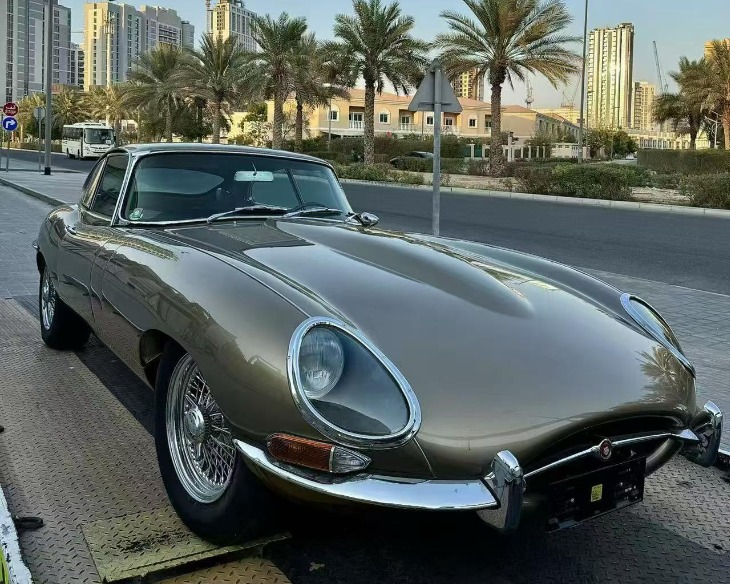
 Exterior · 1 / 6
Key Vehicle Info
Description
I am offering this 1964 Jaguar E-Type Series 1 Fixed Head Coupé in Dubai. Finished in a deep metallic grey with a light beige leather cabin, wood-rim steering wheel and classic polished details, it has the long bonnet, compact cockpit and flowing fastback roofline that made the E-Type one of the most celebrated sports-car designs of the twentieth century. Six photographs show the actual car from multiple exterior angles and inside the cabin. Contact me by phone or WhatsApp for the current asking price and a private viewing.
✨ A landmark shape
The E-Type was created around a low frontal area, a long clamshell bonnet and a body whose proportions still look dramatic more than six decades later. This Fixed Head Coupé combines the enclosed fastback profile with the intimate two-seat layout of the original Series 1. The covered headlamps, small grille opening, slender bumpers and narrow tail all contribute to the purity collectors seek in an early E-Type.
I encourage a daylight viewing because this shape rewards careful inspection from every angle. Walk around the bonnet, front wings, doors, roof, hatch and rear quarters. Look along the reflections to assess panel straightness and paint finish, then compare the gaps around the bonnet, doors and rear hatch. The E-Type structure and outer panels require specialist knowledge, so an experienced classic-Jaguar body inspection is welcome.
🏁 Series 1 character
Jaguar Daimler Heritage records the original Series 1 E-Type as a 3.8-litre XK straight-six sports car offered as an open two-seater or Fixed Head Coupé. During 1964 Jaguar began the transition to the 4.2-litre engine, making the chassis number, engine number, body number and production date essential when identifying an individual car. I welcome verification through a Jaguar Heritage Certificate and inspection of all stamped and numbered components.
The catalog mapping for this listing is Series 1 Fixed Head Coupé, with the 3.8-litre specification used as the historical reference. The buyer should confirm whether this car retains its factory engine, gearbox, body configuration, colours and matching numbers. A Heritage Certificate can establish the original build date, dispatch destination, exterior colour, interior colour and numbered components without relying on appearance alone.
⚙️ XK straight-six engineering
The classic 3.8-litre Series 1 specification uses Jaguar's twin-cam XK straight-six with triple SU carburettors, rated historically at 265 bhp, paired with a four-speed manual gearbox and rear-wheel drive. The engine is known for smooth torque, an evocative exhaust note and strong performance by the standards of its era. A properly prepared E-Type should start cleanly, settle into a consistent idle and respond progressively once warm.
A viewing should begin from cold. Check oil level and coolant before starting, observe oil-pressure rise, listen to the timing chains and valve gear, and watch for smoke, fuel leakage or coolant loss. As temperature builds, confirm stable charging, cooling-fan operation and consistent carburettor response. The cooling system, hoses, radiator, water pump, thermostat and ignition should be assessed by a Jaguar specialist before an extended road test.
Triple carburettors require correct synchronization and healthy linkages. Inspect the air-filter assembly, fuel lines, floats, manifolds and throttle mechanism. A specialist can perform compression and leak-down tests, inspect spark plugs and ignition timing, and review the engine mounts and exhaust system. These checks are part of responsible ownership for a high-value classic and create a reliable baseline for future maintenance.
🕹️ Four-speed manual experience
The manual gearbox gives the E-Type much of its character. With the car stationary, check clutch travel, hydraulic condition and selection of every gear. During a controlled drive, shifts should engage cleanly without jumping out of gear, excessive noise or persistent synchromesh protest. The clutch should take up progressively without slip, judder or a heavy release-bearing sound.
Inspect the gearbox, propeller shaft, universal joints, differential and rear-drive assembly for leakage, wear and vibration. The independent rear suspension carries the inboard rear brakes and differential in a compact cage, so a workshop lift is especially valuable. A technician familiar with E-Types can inspect mounts, seals, driveshafts, bearings and the condition of the rear suspension cage.
🛞 Suspension, steering and brakes
One reason the E-Type was so advanced is its independent rear suspension, combined with double-wishbone front suspension, rack-and-pinion steering and four-wheel disc brakes. These systems should feel coherent rather than loose or harsh. On a safe route, assess straight-line stability, steering play, self-centring, brake balance and the way the body settles after bumps.
Inspect front wishbones, torsion bars, ball joints, dampers, anti-roll-bar links, steering mounts and wheel bearings. At the rear, review radius arms, universal joints, coil-over units, hubs and the inboard brake hardware. Rubber components, hydraulic hoses and seals can deteriorate with age even when mileage is limited, so condition and service dates matter more than appearance.
Tyres strongly affect an E-Type's steering and ride. Check that the fitted size, load and speed ratings suit the car and wheels, and review manufacturing dates, tread condition and sidewalls. Wire or period-style wheels should be inspected for damage, runout, spoke condition and correct mounting. Wheel balance and alignment can transform the driving experience.
🎨 Body structure and corrosion inspection
The E-Type combines a central monocoque with front engine frames supporting the bonnet, suspension and powertrain. Structural inspection should cover the floors, inner and outer sills, bulkhead, rear arches, boot floor, suspension mounting points, bonnet structure and engine frames. Repairs must be evaluated for quality, alignment and faithfulness to the original construction.
Use a paint-depth gauge as one part of the review, but do not rely on readings alone. Classic cars may have undergone restoration, panel replacement or refinishing during their lives. What matters is that the work is documented, structurally correct and professionally executed. Ask for restoration photographs, invoices and parts records where available, and compare them with the car itself.
Door fit, bonnet closure and rear-hatch operation should be tested repeatedly. Check glazing, rubber seals, chrome, lamp lenses, mirrors and exterior handles. Inspect underneath for corrosion, impact damage, fluid leakage and previous repairs. A borescope can help examine enclosed areas that are difficult to judge from the surface.
🪵 Classic two-seat cabin
The light beige interior shown here provides a warm contrast to the grey body. The wood-rim steering wheel, Smiths-style instruments, toggle switches and narrow centre console create the purposeful atmosphere of an early 1960s British sports car. Sit in both seats and check adjustment, mounting, belts, door latches, window operation and visibility.
Inspect leather, stitching, carpets, headlining, dashboard covering, door cards and luggage surfaces. Confirm that instruments, warning lamps, switches, wipers, washers, horn, heater, demister and interior lights work correctly. Electrical reliability depends on sound wiring, grounds, fuses, relays and charging components, so a careful electrical inspection is worthwhile.
Any modern additions should be documented and assessed for reversibility. Upgraded cooling, ignition, braking or electrical components can improve usability when installed thoughtfully, while poorly integrated modifications may complicate maintenance or reduce originality. The final value judgement should consider authenticity, safety, quality and the buyer's intended use.
📚 Documentation and provenance
For a collector E-Type, documentation is part of the vehicle. Match the chassis number against the registration, body and available records. Review the Heritage Certificate, ownership history, restoration invoices, maintenance receipts, old photographs, manuals, keys and tool kit. A coherent history supports both confidence and future value.
Confirm import and registration status in the UAE, current ownership, insurance eligibility and any finance or legal encumbrance before transfer. Because classic-car identification practices differ from modern VIN systems, the inspection should be completed by a specialist who understands Jaguar number locations and production records.
🌡️ Ownership in Dubai
Dubai use places special importance on cooling, fuel-system condition, battery health and careful storage. The car should be kept in a dry, climate-controlled space where possible and driven regularly enough to circulate fluids and exercise seals. Tyre pressures, coolant protection, brake fluid and fuel quality should be monitored closely.
A sensible initial plan includes all fluids, filters, ignition components, carburettor tune, cooling-system assessment, brake inspection, tyre review and lubrication of hinges and linkages. Establish relationships with a classic-Jaguar workshop, a knowledgeable body specialist and a parts supplier before undertaking long journeys.
🧭 Viewing and road-test plan
Allow enough time for a cold start, static inspection, lift inspection and road test. Begin with identity numbers and documents, then examine the body, cabin, engine bay and underside. On the road, build speed gradually while monitoring oil pressure, coolant temperature, charging and unusual sounds. Include low-speed turns, normal braking, gear changes and a steady cruise.
After the drive, let the engine idle, recheck for fluid leakage, inspect temperatures and listen for changes as components heat soak. A second look underneath can reveal issues not visible before the test. I welcome an independent pre-purchase inspection and a written report so the buyer can make a clear collector-car decision.
💎 A usable piece of design history
This 1964 Jaguar E-Type Fixed Head Coupé offers much more than visual impact. It represents a landmark combination of aerodynamics, XK engine performance, independent suspension and disc brakes, wrapped in a shape associated with the height of 1960s British sports-car design. Its grey exterior and beige cabin give it an elegant, understated presentation.
Contact me by phone or WhatsApp to discuss the current asking price, documents and viewing arrangements in Dubai. Serious collectors are welcome to bring a Jaguar specialist, verify the chassis and Heritage Certificate, inspect the car on a lift and complete a careful road test before agreeing terms.
Model Overview
1964 Jaguar E-Type Series 1 Fixed Head Coupe transitional year covering 3.8L and 4.2L cars.
Full Specifications
- Body Type
- Coupe
- Condition
- Used
- Model Year
- 1964
- Regional Specs
- Other
- Exterior Color
- Dark Grey
- Interior Color
- Beige
- Engine
- 3800
- Horsepower
- 265 bhp
- Cylinders
- 6
- Fuel Type
- Petrol
- Transmission
- 4-Speed Manual
- Doors
- 2
- Seats
- 2
- Steering Side
- Left
- Warranty
- No
- Trim
- Series 1 FHC (1964)
Prices and Spec below are official new-car list prices and spec for each trim — used as a reference only.
Trim Prices
Trim Specs
Jaguar currently has 1 new car in UAE. Their current line up includes SUV. Current starting prices are from AED 256,620 and go up to AED 450,000, depending on the model and trim. The most popular model sold by Jaguar in UAE is the F-Pace. The cheapest Jaguar available is the F-Pace while the most expensive is the F-Pace. Each vehicle is listed with detailed specifications, features, and up-to-date prices to help buyers compare and choose the right Jaguar for their needs in UAE.
notice:Please verify the listing and seller carefully. Listings are uploaded by users, and you should avoid advance payments, unusual transfers, or suspicious requests.